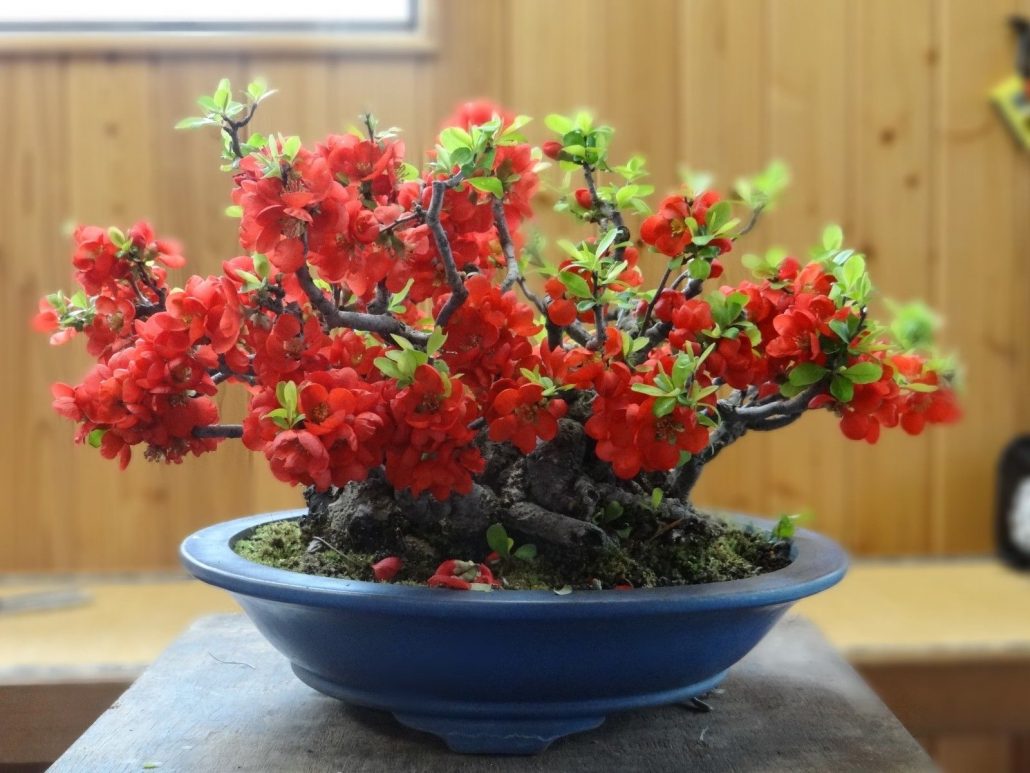
Chaenomeles, commonly called Japanese quince or flowering quince, is a deciduous shrub belonging to the Rosaceae family and native to China and Japan. Known for its spectacular and early flowering, which often occurs in late winter or early spring, before the leaves are released, it is among the most beautiful and easy-to-grow bonsai trees. The flowers - white, pink, orange or red - sprout on the still bare branches, forming cheerful coloured masses that produce a striking contrast on bare wood. The flowering, always rather generous, can give rise to fragrant ornamental fruits that make the plant very attractive even in winter. It is suitable for almost all styles, especially for rafts.
Location
Chaenomeles bonsai should be kept outdoors all year round, preferably in a sunny position or in light partial shade. To obtain abundant flowering, it is necessary to expose it to full sun. However, it does not tolerate prolonged exposure to the scorching summer sun: during these periods, it may be useful to provide it with light shade. In winter, it tolerates the cold well, but it is advisable to protect it in case of intense or prolonged frost, especially during flowering. It needs good ventilation.
Watering
The common rule of watering whenever the soil feels dry to the touch is also ideal for Chaenomeles, bearing in mind, however, that in hotter periods and in strong winds, it is necessary to water more frequently. In fact, in these cases, the soil often risks becoming completely dry. It is also important to bear in mind that both a lack of water and an excess of water can cause serious imbalances in the plant.
Repotting
Chaenomeles bonsai should be repotted every 2-3 years, preferably in spring immediately after flowering, when it still has energy but has not yet fully developed its foliage. The root system is dense and resistant, but the plant does not like overly severe pruning. About one-third of the roots can be removed, always maintaining a good balance between the roots and the aerial part. The ideal substrate is well-drained and slightly acidic: 50% Kanuma + 40% Akadama + 10% pozzolana.
Pruning
To obtain more intense flowering, allow new shoots to grow without pruning throughout the summer, then shorten them to 2 nodes of the year's growth in mid-autumn. Remove all basal suckers.
Pinching
If you are working on a specimen that is already at a good stage of finishing, pinch the ends of the shoots when they reach a length of 2-3 cm, so as not to ruin the shape. This is a fundamental point of cultivation because, by carefully pinching the shoots, you can obtain a thick, fine external branching.
Wiring
Chaenomeles can be shaped using wire, but care must be taken as its branches are fragile and break easily. In addition, many branches have small thorns, which make the operation more delicate. It is preferable to work on young, flexible branches in spring or fall, avoiding periods of full flowering or fruiting and winter.
Fertilization
Chaenomeles needs balanced nutrients to maintain overall health and support flower and fruit production. It is advisable to fertilize regularly from the end of flowering after pruning every 15 days until October, excluding July and August. During flowering, it is best to suspend fertilization so as not to interfere with the plant's energy balance. In autumn, a fertilizer low in nitrogen and richer in phosphorus and potassium can be used to prepare the plant for winter and promote bud differentiation for the following year. Avoid excess nitrogen, which can reduce flowering.
Care
It can be affected by aphids, quince monilia, collar galls, and bacterial necrosis. Good exposure, aeration of the canopy, and removal of fallen leaves help prevent these problems. It is important to keep the substrate well drained to avoid root rot. The fruits, if present, can be left for ornamental purposes, but it is advisable to remove them before winter if the plant shows signs of fatigue.
0 commenti :
Post a Comment