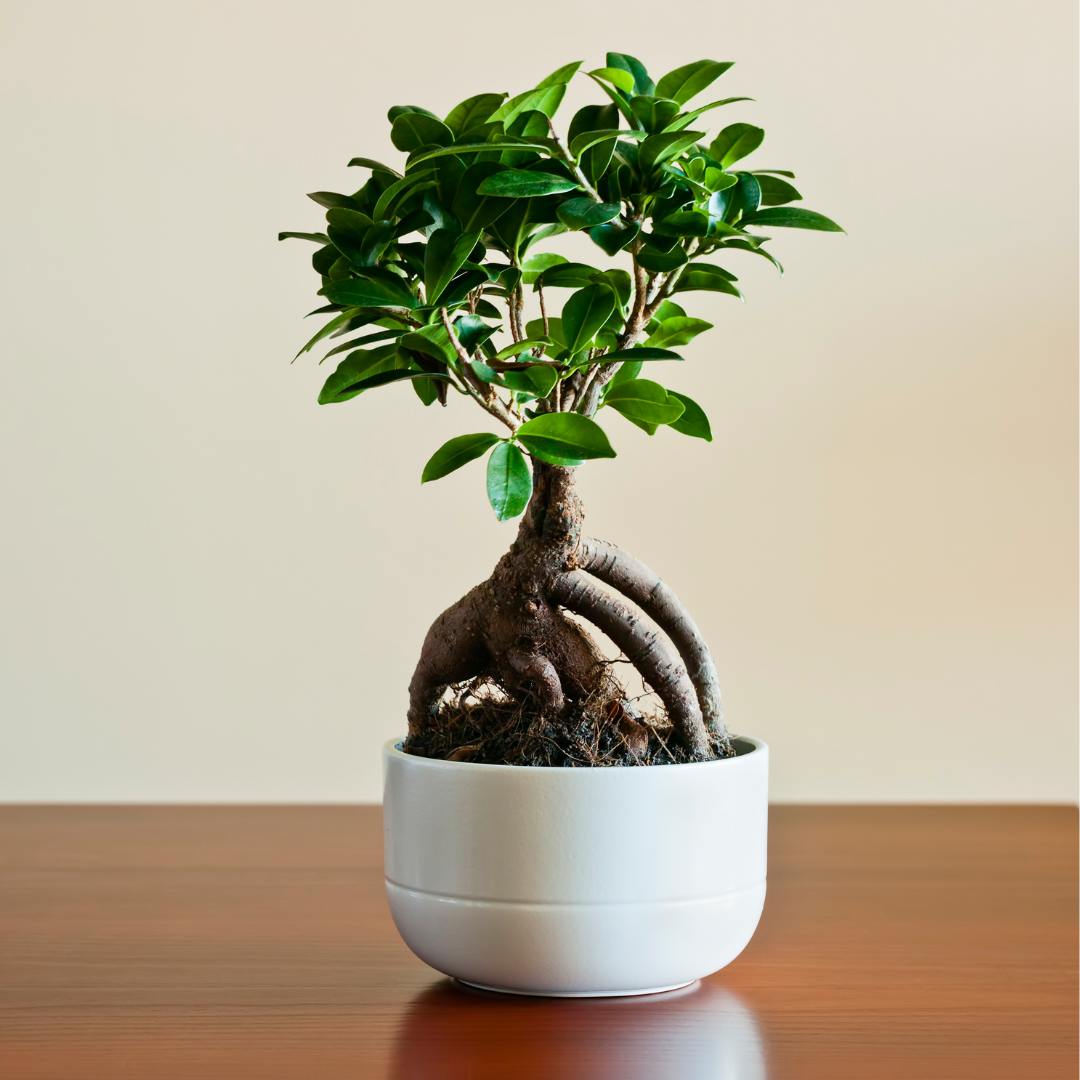
Ficus retusa is the quintessential indoor evergreen bonsai. Native to tropical Asian forests, it's ideal for all enthusiasts because it's easy to grow and adapts to almost any environmental condition. It stands out from other Ficus species for its ability to develop majestic aerial roots.
Location
If placed outdoors it shows better growth, but this is only possible from May to September, since when the temperature drops below 10° C it is necessary to bring it indoors to a very bright position, less than 1 metre from the window not screened by curtains.
Watering
The common rule of watering that indicates to wet whenever the soil is dry to the touch, is also ideal in the case of Ficus retusa, considering that in the warmer periods, it is necessary to intervene more frequently. Often, in this case, the soil is likely to remain completely dry. It is also good to keep in mind that both the lack and the excess of water can create serious imbalances to the plant. However, it likes the moisture on the frond, so it is advisable to vaporize the leaves.
Repotting
The most suitable time is April-May. Since the roots grow rapidly and recover early from the wounds, it is possible to prune the strain without fear, leaving only a third. Given the speed of growth, it is operated every two years on young specimens, every three on adult specimens. Special attention deserves the aerial roots: care must be taken not to break them, cleaning the lower and upper part of the strain. The ideal compound consists of akadama (80%) and soil (20%).
Pruning
In principle, especially in the case of cutting large branches, the Ficus do not tolerate drastic pruning. This does not mean that if it were applied, the plant would be lost, but the scar resulting from the pruning of a branch larger than 1/3 compared to the thickness of the trunk, in most cases heals with difficulty.
The cause of this poor wound closing capacity is to be found in the wood type of Ficus. When it comes instead to medium or thin branches (less than 1/3 of the trunk diameter), all Ficus respond by emitting new and abundant buds near the cutting area. The vigor of the species and the stapling will require the periodic thinning of the secondary and tertiary branches. If the Ficus grows healthy, twice a year the branches that develop downwards, inwards of the trunk and cross with others, are eliminated. Shortening the length of a branch means replacing the apex with a back shoot.
Stapling
Ficus stapling is practiced throughout the year because, if kept inside during the winter, the growth is continuous. Being very vigorous, they need a frequent stapling to control its strong apical dominance: you let the shoots grow up to 5 or 6 leaves and then cut 2-3 leaves, according to the vigor of each area. Stapling with the fingers, that is, through the removal of the last two leaves can only be applied to adult specimens; in young specimens it curbs too much growth, thus slowing down the branching process.
Wrapping
Winding is only one of the many techniques applicable to Ficus to give shape to trunk and branches, but it is undoubtedly the most dangerous. Ficus are flexible, so modeling them is not a difficult task, but you have to pay attention to the rapid growth of this plant. If you do not pay enough attention, the thread can affect the cortex quickly. For this reason it is better to avoid the use of thin wire and in any case the practice of winding will have to be adopted only if you can not use the shaping with the rods.
Fertilization
To the vegetative recovery (March-April) fertilize every 8-10 days combining the Bonsan Fertise with Stimulant Action with the Organic Liquid Fertilizer Bonsan. From April to September fertilize every 8-10 days with Organic Liquid Fertilizer Bonsan or every 15-20 days with Bonsan Organic Solid Concime Aburukasu, avoiding the months of July and August. From September to February use the Bonsan Organic Liquid Fertilizer every 15-20 days. To stimulate rooting, use Organic Mineral Fluid Fertilizer with B Bonsan vitamins instead of Bonsan Organic Liquid Fertilizer.
Care
Ficus can be assaulted by caterpillars and occasionally by thrips. More rare, but possible, is the red spider attachment. Much more frequent are the attacks of fungi, which occur when you hold the plant in a warm position, with little light, poor ventilation and high humidity. On the leaves appear bright blackish spots, molds sometimes covered by a white dust or yellowish blisters. It is therefore necessary to place the plant in a more aerated position, applying a fungicide.
0 commenti :
Post a Comment