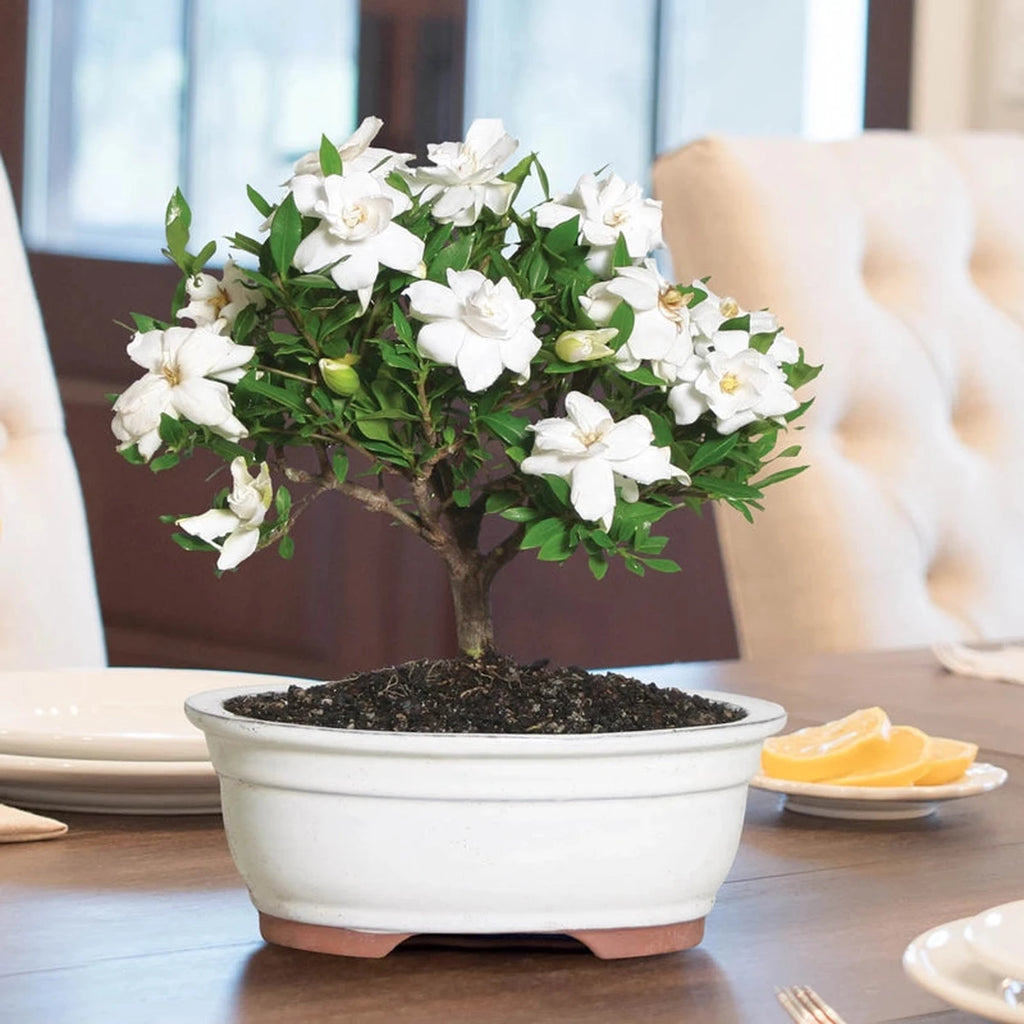
The gardenia bonsai, most commonly Gardenia jasminoides (Cape jasmine), is one of the most rewarding—and somewhat demanding—flowering bonsai. Its glossy evergreen leaves, white waxy flowers, and powerful fragrance make it especially attractive, but it needs careful attention to water, acidity, light, humidity, temperature, and pruning. RRHS+1
Gardenia Bonsai at a Glance
Requirement
What to aim for
Botanical name
Gardenia jasminoides
Type
Evergreen flowering shrub
Light
Very bright light; gentle morning sun is ideal
Water
Keep evenly moist, never permanently soggy
Soil
Acidic, porous, fast-draining
Preferred pH
Roughly 5–6.5
Humidity
High, with good air circulation
Temperature
Warm; protect from frost and cold roots
Fertilizer
Regular feeding during active growth
Pruning
Mainly after flowering
Repotting
Usually every 2–3 years, depending on root growth
Flowering
Generally late spring through summer
Main problems
Chlorosis, bud drop, root problems, scale/mealybugs/aphids
RRHS+2
1. Choosing the Right Gardenia
Most gardenia bonsai are based on Gardenia jasminoides. Compact forms such as 'Radicans' are particularly useful for bonsai because their smaller leaves and naturally compact growth can produce better proportions. KKigi Bonsai+1
When buying one, look for:
-
Dark, glossy green leaves.
-
Numerous healthy shoots.
-
No widespread yellowing.
-
A firm trunk and healthy root system.
-
No scale, mealybugs, aphids, or webbing.
-
Ideally, several unopened flower buds.
Avoid a tree that is severely yellow, badly wilted, or sitting in permanently saturated soil.
2. Light
Gardenia needs strong light, but excessive hot sunlight can scorch foliage and stress the roots.
A good arrangement is:
-
Morning sun: excellent.
-
Bright filtered light: excellent.
-
Hot afternoon sun: provide protection, particularly in summer.
-
Deep shade: avoid.
Gardenias grown indoors should be placed in the brightest suitable location available. RHS recommends bright light while avoiding strong direct sun, while bonsai growers commonly recommend several hours of gentle direct light. RRHS+1
If your gardenia is indoors, don't put it directly beside a heater, air conditioner, or drafty window.
3. Watering
Watering is arguably the most important part of gardenia bonsai care.
The objective is:
Moist, oxygenated roots—not dry roots and not permanently saturated roots.
Check the soil frequently. When the surface is beginning to dry, water thoroughly until water runs freely from the drainage holes.
Don't follow a rigid schedule such as "every three days." A small bonsai pot can dry dramatically faster in hot, windy weather than in cool, humid conditions.
During hot weather
Your tree may need water every day, and sometimes more than once a day if the pot is extremely small and conditions are hot.
During winter
Reduce watering as growth slows, but don't allow the root ball to become completely dry. RRHS+1
Water quality matters
Gardenias are acid-loving plants. Hard or alkaline water can gradually raise the substrate pH and contribute to iron deficiency and yellow leaves.
Rainwater is useful where available, particularly if your tap water is hard. RRHS
4. Humidity
Gardenias appreciate high humidity, but humidity shouldn't mean stagnant, constantly wet foliage.
Helpful measures include:
-
A humidity tray.
-
Grouping plants together.
-
Good ventilation.
-
Outdoor placement in suitable warm weather.
-
Avoiding dry heating vents.
A humidity tray should increase atmospheric humidity without leaving the bonsai pot sitting directly in water. RRHS+1
5. Soil and pH
This is another critical point.
Gardenia is an acid-loving plant, and a suitable bonsai substrate needs to provide both acidity and excellent drainage. RHS recommends acidic, peat-free ericaceous compost for gardenias. RRHS
For bonsai, you want a mix that:
-
Holds enough moisture for the gardenia.
-
Drains rapidly.
-
Contains plenty of air spaces.
-
Doesn't compact easily.
-
Maintains an appropriately acidic environment.
A specialist acidic bonsai mix can work well. Some growers use combinations involving akadama, pumice/volcanic material, pine bark, kanuma, or other acidic components. The exact recipe should be adapted to your climate and watering habits rather than treated as a universal formula. KKigi Bonsai+1
Why yellow leaves appear
If the leaf veins remain green while the tissue between them turns yellow, iron availability and high substrate pH are possible causes. Gardenias can develop chlorosis when conditions become too alkaline. GGardenia+1
Don't automatically respond to yellow leaves with more fertilizer. First check:
-
Soil moisture.
-
Drainage.
-
Root health.
-
Light.
-
Water quality.
-
Soil pH.
6. Fertilizing
Gardenias are relatively hungry plants during active growth.
A balanced fertilizer suitable for acid-loving plants can be used during the growing season, following its label dilution. Some growers use a complete liquid fertilizer at reduced strength to avoid excessive salt accumulation in the small bonsai pot. RRHS+1
Avoid continuously heavy fertilization. Excess salts can damage roots and create additional problems.
A useful rule is:
Healthy roots + adequate light + appropriate pH first; fertilizer second.
7. Pruning
Pruning is where gardenia bonsai differs from simply growing a gardenia shrub.
Gardenias flower on mature/older shoots, so aggressive pruning at the wrong time can remove next season's flower potential. A major pruning session is generally best performed after flowering. JJackson & Perkins
After a shoot has extended substantially, it can be cut back to maintain the bonsai's structure and encourage branching. One bonsai-growing guideline recommends allowing a shoot to develop around 6–8 leaves and reducing it to about 3 leaves. MMistral Bonsai
Don't blindly apply that number to every tree, however. The appropriate cut depends on:
-
Tree vigor.
-
Branch thickness.
-
Desired silhouette.
-
Position of buds.
-
Whether you're trying to preserve flowers.
Pinching
Light pinching during active growth can encourage a compact canopy, but don't pinch every growing tip if you want flowers—the developing terminal growth may contain future flower buds.
8. Flowering
The flowers are the main attraction.
Gardenia flowers are usually:
-
White to creamy white.
-
Highly fragrant.
-
Waxy in texture.
-
Relatively large compared with the leaves.
They generally appear from late spring into summer, although exact timing depends on cultivar and growing conditions. RRHS+1
Why do gardenia buds fall off?
Bud drop can result from several stresses, including:
-
Sudden temperature changes.
-
Drying out.
-
Excessive heat.
-
Insufficient light.
-
Root problems.
-
Excessively wet soil.
-
Low humidity.
-
Moving the plant while buds are developing.
Gardenias particularly dislike abrupt environmental changes. RRHS
When a tree is full of buds, stability is more valuable than constant adjustment.
9. Repotting
Repot when the tree is actively capable of recovering, generally during a warm growing period appropriate to your climate.
Many gardenia bonsai are repotted approximately every 2–3 years, although a vigorous tree in a small pot may require attention sooner. BBonsai-Express.com+1
When repotting:
-
Remove the tree carefully.
-
Examine the roots.
-
Remove degraded old substrate.
-
Trim unhealthy or excessively circling roots.
-
Avoid an unnecessarily aggressive root reduction.
-
Use fresh acidic, well-draining substrate.
-
Water thoroughly afterward.
-
Keep the tree protected from extreme conditions while recovering.
The commonly repeated advice to remove a fixed percentage of roots shouldn't be treated as a universal rule. Root pruning should be proportional to the tree's health, root density, season, and aftercare capacity.
10. Wiring
Gardenia can be wired, but care is needed.
Its branches can become brittle, while its smooth bark can show wire marks relatively easily. Check wired branches frequently and remove or reposition wire before it bites into expanding tissue. KKigi Bonsai
For many gardenias, clip-and-grow is preferable for developing fine ramification.
11. Pests
Common gardenia pests include:
-
Aphids.
-
Scale insects.
-
Mealybugs.
-
Whiteflies.
-
Spider mites, particularly under dry conditions.
Inspect the undersides of leaves and young shoots regularly. JJackson & Perkins+1
Also watch for sooty mold. Its presence can indicate honeydew-producing insects such as scale or aphids rather than being the primary problem itself.
12. Yellow Leaves: A Troubleshooting Guide
Symptom
Possible cause
Yellow leaves + green veins
High pH/iron availability problem
Yellow leaves + constantly wet soil
Root stress/poor drainage
Yellow leaves + very dry soil
Underwatering
Buds fall suddenly
Environmental stress or inconsistent moisture
Brown/scorched leaves
Excessive sun, heat, dry air, or root problems
Sticky leaves
Aphids, scale, or other sap-sucking insects
Black coating on leaves
Often sooty mold associated with insect honeydew
Fine webbing
Possible spider mites
Don't diagnose solely from leaf color; inspect the roots, substrate, watering pattern, and environment together.
13. Indoor vs. Outdoor Growing
Despite being sold frequently as an "indoor bonsai," gardenia isn't inherently an indoor plant.
In a warm, frost-free climate, it can be grown outdoors in a sheltered position. In colder climates, it needs protection from low temperatures and may be brought indoors during winter. RHS recommends protecting gardenias from frost and moving them indoors when temperatures become too low. RRHS
For an indoor tree, provide:
-
Maximum practical natural light.
-
High humidity.
-
Good air circulation.
-
Stable temperatures.
-
Careful watering.
-
Distance from heating/cooling vents.
14. Seasonal Care
Spring
-
Increase watering as growth resumes.
-
Begin regular fertilization.
-
Repot if necessary.
-
Carry out structural pruning at the appropriate time.
-
Gradually increase light exposure.
Summer
-
Monitor moisture very closely.
-
Protect from extreme afternoon heat.
-
Feed regularly.
-
Allow selected shoots to develop for flowering.
-
Watch carefully for pests.
Autumn
-
Reduce fertilizer as growth slows.
-
Monitor temperature.
-
Prepare for winter protection.
-
Don't allow the tree to experience abrupt environmental changes.
Winter
-
Keep it bright.
-
Protect from frost and cold drafts.
-
Water less frequently, but don't let the root ball dry completely.
-
Maintain reasonable humidity.
-
Avoid heavy pruning or repotting unless there's a compelling reason.
15. A Simple Care Routine
If you're new to gardenia bonsai, keep the routine simple:
Every day
-
Check moisture.
-
Look for wilting or sudden environmental stress.
-
Check developing buds during flowering season.
Every week
-
Inspect leaves and shoots for pests.
-
Check the soil and drainage.
-
Rotate the tree if necessary for even growth.
During active growth
-
Fertilize according to the product's instructions.
-
Pinch selectively.
-
Maintain strong light.
After flowering
-
Perform structural pruning.
-
Remove spent flowers.
-
Shape the developing canopy.
Every few years
-
Inspect the root system and repot when necessary.
The Golden Rules
If you remember only six things, remember these:
-
Give it lots of light.
-
Never let it become bone-dry.
-
Never leave the roots permanently waterlogged.
-
Keep the root environment acidic.
-
Protect it from frost and severe temperature swings.
-
Do major pruning after flowering rather than immediately before it.
Gardenia bonsai rewards consistency. The biggest mistake is usually trying to solve one problem—yellow leaves, lost buds, weak growth—by adding more fertilizer or water without first checking the underlying growing conditions. Healthy roots, appropriate acidity, stable moisture, adequate light, and warmth form the foundation for everything else.
0 commenti :
Post a Comment