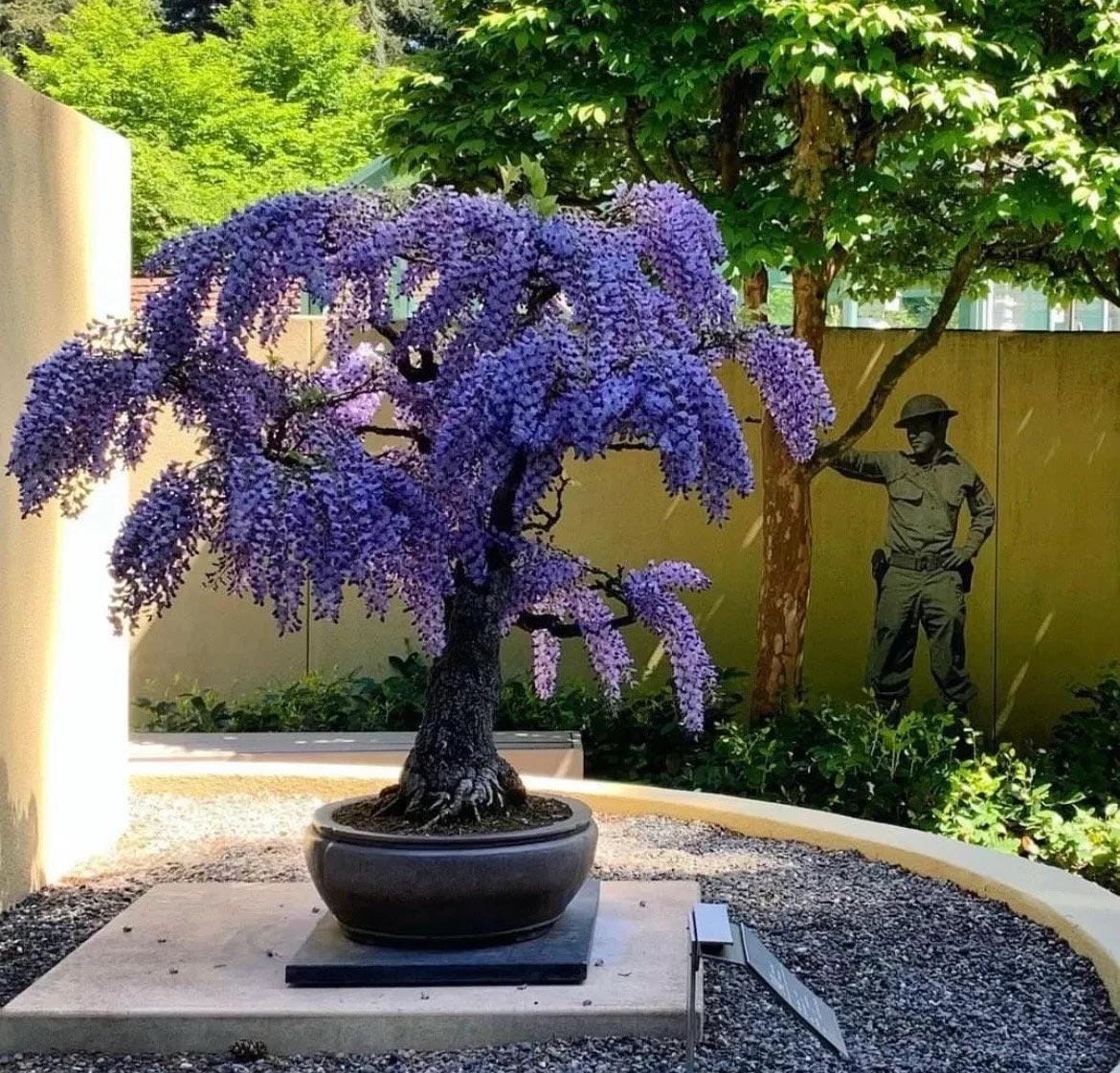
A Glicine (Wisteria) bonsai is one of the best candidates for a sunny patio. It is an outdoor, deciduous, vigorous plant that needs strong light, plenty of water during active growth, regular pruning, and a genuine winter dormancy.
The key is to let it grow strongly when you need thickness, then control that growth when you want refinement and flowering.
The calendar below is written for the Southern Hemisphere, so spring begins around September and autumn around March. Adjust the timing according to your actual local weather and the tree's growth cycle.
1. The ideal patio setup
A practical setup should provide:
☀️ Full sun
→ good airflow
→ excellent drainage
→ easy access to water
→ ✂️ space for vigorous shoots
→ ❄️ a sheltered position for extreme winter weather
Position
Choose the sunniest practical location.
Wisteria generally benefits from several hours of direct sunlight, especially for flowering.
An ideal patio location has:
-
Morning sun.
-
Strong light through the day.
-
Good ventilation.
-
Protection from exceptionally strong wind.
-
Some ability to provide temporary afternoon shade during extreme heat.
-
No standing water around the pot.
Unlike gardenia, don't deliberately put wisteria in a shaded corner simply to protect it from summer sun.
2. Use a bonsai stand
Place the pot on a raised stand rather than directly on concrete or tiles.
This provides:
-
Better drainage.
-
Air circulation beneath the pot.
-
Less heat transfer from paving.
-
Easier inspection of the drainage holes.
-
Better protection against pests that hide beneath containers.
During very hot weather, remember that the pot can become hotter than the surrounding air.
If your patio has dark tiles, concrete or walls that reflect heat, consider temporarily moving the pot or shading the container.
3. Choose a suitable pot
Wisteria develops a strong root system and can be vigorous.
Don't force a young, developing tree into an extremely small refinement pot too early.
Development tree
Use a somewhat larger training container so that:
-
The trunk can thicken.
-
Primary branches can develop.
-
The tree can build strength.
Mature bonsai
Once the structure is established, gradually move toward an appropriately proportioned bonsai container.
The important thing is to balance:
container size + root volume + top growth + flowering.
4. Soil and drainage
Wisteria likes moisture, but it doesn't want permanently stagnant roots.
Use a porous bonsai substrate that retains some moisture but drains freely.
A mixture based on materials such as:
-
Akadama.
-
Pumice.
-
Lava rock.
-
Suitable organic material.
can work well.
The exact proportions should reflect your climate.
Hot and dry patio
Use somewhat greater moisture retention.
Cool and wet patio
Use a more freely draining mixture.
Avoid ordinary garden soil in the bonsai container because it can compact and reduce root-zone oxygen.
5. Watering system
Wisteria is one of the bonsai species for which daily summer checking is particularly important.
Don't use a rigid schedule such as:
"Water every Tuesday and Friday."
Instead:
Check → water thoroughly when necessary → drain completely → check again.
How correct response to hot weather is not automatically to keep the to water
When the substrate begins drying:
-
Water slowly.
-
Thoroughly wet the entire root ball.
-
Continue until water flows freely from the drainage holes.
-
Allow excess water to drain.
-
Return the tree to its normal position.
Avoid repeatedly giving tiny amounts of water to the surface.
6. Summer watering
During active summer growth, wisteria can consume a surprising amount of water.
Check the tree:
every morning
and again during exceptionally hot or windy weather.
A small pot exposed to full sun may dry very quickly.
The correct response to hot weather is not automatically to keep the substrate permanently saturated. The roots still need oxygen.
Think:
wet thoroughly → drain → partial drying → water again
rather than:
always wet.
7. Fertilizer
Wisteria is a vigorous grower and generally responds well to regular feeding.
Spring
Begin feeding once active growth has started.
Summer
Continue regular feeding while the tree is actively growing.
Late summer/autumn
Gradually reduce feeding as growth slows.
Winter
Stop routine fertilizer during dormancy.
A balanced bonsai fertilizer is sufficient for most situations.
If the tree is producing excessive leaves and very long shoots but flowering poorly, avoid simply increasing fertilizer.
More fertilizer is not necessarily more flowers.
8. The most important flowering principle
If your objective is a beautiful flowering wisteria bonsai, don't prune it as though you're simply trying to maintain a miniature foliage tree.
You need to preserve and develop mature flowering wood and short spurs.
Flowering depends on several factors:
-
Sunlight.
-
Maturity.
-
Correct pruning.
-
Adequate nutrition.
-
Controlled vigor.
-
Winter dormancy.
A very young tree may simply not be mature enough to flower.
9. Spring routine
September–October
This is the major awakening period in a Southern Hemisphere climate.
Look for:
-
Swelling buds.
-
New shoots.
-
Flower buds.
-
Expanding leaves.
At this stage
-
Increase watering as growth accelerates.
-
Begin fertilization.
-
Give maximum practical sunlight.
-
Monitor developing flower buds.
-
Protect new growth from unexpected severe frost.
-
Avoid unnecessary pruning of flowering structures.
If the tree needs repotting, this is generally one of the important windows to consider, depending on your local climate and the tree's development.
10. Spring flowering
Depending on species, cultivar and climate, wisteria can flower around spring.
When flower clusters appear:
Don't untouched, these shoots can destroy the intended bonsai and the tree's development stage rather than applying one number an unheated cold frame or similar shelter during exceptionalot simply disturb the tree unnecessarily.
Avoid:
-
Major repotting.
-
Severe pruning.
-
Sudden relocation.
-
Severe drought.
-
Major environmental changes.
Maintain consistent moisture and good light.
Then enjoy the flowers.
11. After flowering
Once flowering has finished, the tree can return to its normal vigorous growth cycle.
This is a good time to start managing the long shoots.
Wisteria can produce very long extensions surprisingly quickly.
If left untouched, these shoots can destroy the intended bonsai silhouette.
12. Summer pruning
This is one of the most important parts of the routine.
Allow shoots to extend enough to develop strength, then shorten unwanted growth.
A useful conceptual cycle is:
long shoot
↓
allow it to mature
↓
cut back
↓
new lateral growth
↓
shorter flowering/ramification structures
The exact number of leaves to retain should depend on the branch and the tree's development stage rather than applying one number mechanically to every shoot.
13. Development vs. refinement
This distinction makes wisteria care much easier.
If your tree is still developing
Prioritize:
-
Trunk thickness.
-
Primary branch thickness.
-
Root development.
-
Overall vigor.
Allow selected branches to grow much longer than you ultimately want.
Then cut them back later.
If your tree is already mature
Prioritize:
-
Short internodes.
-
Fine branching.
-
Flowering wood.
-
Silhouette.
-
Controlled shoot extension.
Don't allow every branch to run freely.
14. A sacrifice branch
A sacrifice branch can be extremely useful on a young wisteria.
You deliberately allow one shoot to grow strongly because its purpose is to thicken a trunk or branch.
Once the desired thickness is achieved:
remove the sacrifice branch.
This is often much faster than trying to thicken everything while keeping the tree perfectly refined.
15. Wiring
Wisteria can be wired, particularly while branches are young.
However, vigorous growth can make wire bite into branches quickly.
Therefore:
Check wire frequently during spring and summer.
Remove it before it becomes embedded.
For older branches, avoid forcing extreme bends.
Wisteria naturally has a flowing, twisting growth habit, so clip-and-grow is often an excellent primary technique.
16. Summer heat protection
Wisteria likes sun, but an extremely hot patio can create problems.
During a heat wave:
Protect the pot
-
Keep it off extremely hot concrete.
-
Shade the container if necessary.
-
Protect it from reflected heat.
-
Make sure drainage holes remain unobstructed.
Protect the foliage
Temporary afternoon shade may be appropriate during extreme heat.
Don't permanently move it into deep shade.
The goal is:
strong sunlight under normal conditions + temporary protection during extremes.
17. Autumn routine
March–April
As temperatures begin to decline:
-
Gradually reduce fertilizer.
-
Reduce watering as the tree consumes less.
-
Allow the foliage to mature naturally.
-
Watch for yellowing.
-
Prepare for leaf fall.
Wisteria is deciduous, so the transition to a bare tree is normal.
Don't interpret leaf fall as a health problem.
18. After leaf fall
This is one of the best times to inspect the tree.
Without foliage, you can clearly see:
-
Trunk line.
-
Primary branches.
-
Crossing branches.
-
Deadwood.
-
Long extensions.
-
Structural weaknesses.
You can evaluate the design much more easily.
Major structural pruning is generally best coordinated with the tree's dormant period and local climate.
19. Winter routine
May–August
The tree should remain outdoors and dormant.
Don't bring it into a warm living room.
Winter dormancy is an important part of its natural cycle.
During normal winter conditions
-
Keep it outdoors.
-
Water sparingly.
-
Don't fertilize.
-
Protect it from severe wind if necessary.
During severe freezes
The vulnerable component is primarily the root system in the bonsai pot.
Protect the container by:
-
Moving it to a sheltered position.
-
Placing it against a protected wall.
-
Insulating the pot.
-
Using an unheated cold frame or similar shelter during exceptional freezes.
Avoid putting the dormant tree into a heated environment unless there is no safer alternative.
20. Winter watering
Leafless wisteria requires much less water.
However:
dormant does not mean completely dry.
Check the substrate periodically.
If it is becoming genuinely dry, water appropriately.
Avoid keeping the substrate continuously wet during cold weather.
21. Repotting
Wisteria is vigorous and can fill a container quickly.
A useful general interval is approximately every 2–3 years, but don't repot simply because the calendar says so.
Inspect the root system.
Repot when:
-
Roots have filled the container.
-
The substrate has broken down.
-
Water penetration has become abnormal.
-
Growth has declined without another obvious explanation.
-
The root mass has become excessively congested.
After repotting
-
Water thoroughly.
-
Protect from extreme conditions.
-
Avoid heavy fertilizer until active recovery begins.
-
Give the tree time to re-establish.
22. Monthly patio routine
A simple maintenance system can keep the tree manageable.
Every day in summer
Check:
-
Soil moisture.
-
Leaf condition.
-
Weather.
-
New shoots.
Once a week
Inspect:
-
Wire.
-
Long shoots.
-
Flower buds.
-
Leaf undersides.
-
Pests.
-
Drainage.
Once a month
Review:
-
Overall silhouette.
-
Branch development.
-
Fertilizer program.
-
Root condition.
-
Whether the tree is in development or refinement mode.
23. Southern Hemisphere calendar
Month
Main task
January
Vigorous summer growth; water frequently; prune long shoots
February
Continue summer management; control excessive extension
March
Reduce fertilizer as growth slows
April
Autumn transition; reduce watering
May
Leaf fall/dormancy; inspect structure
June
Winter protection; minimal watering
July
Dormant maintenance; structural planning
August
Prepare for spring; repot if appropriate
September
Bud break; increase water and begin feeding
October
Strong growth/possible flowering; protect flower structures
November
Flowering and post-flowering pruning
December
Strong summer growth; daily water checks and shoot control
This is a framework rather than a rigid timetable. Weather and the tree's actual development should take priority.
24. Common mistakes
❌ Growing it indoors
Wisteria needs outdoor light and seasonal dormancy.
❌ Keeping it in shade
This can result in weak growth and poor flowering.
❌ Letting it dry severely
Its summer water demand can be substantial.
❌ Keeping it constantly saturated
Good drainage remains essential.
❌ Pruning every shoot immediately
You need extension growth to build branches and trunk thickness.
❌ Allowing every shoot to grow unchecked
Wisteria is vigorous enough to overwhelm a bonsai quickly.
❌ Using excessive nitrogen
This can encourage excessive vegetative growth.
❌ Removing mature flowering wood
You may eliminate next season's flowering potential.
❌ Ignoring wire
Fast-growing shoots can engulf wire surprisingly quickly.
❌ Bringing it indoors for winter
The tree needs its dormant period.
25. The ideal patio system
If you want a simple setup that works, think of the tree this way:
☀️ Spring
Wake up → feed → grow → flower
Summer
Grow strongly → water heavily → prune selectively
Autumn
Slow down → reduce feeding → leaf fall
❄️ Winter
Rest → stay outdoors → protect the roots from extremes
Then repeat.
26. Wisteria vs. Ginkgo vs. Gardenia
Since you're working with these species, their patio routines should be distinctly different:
Wisteria
Ginkgo
Gardenia
Location
Outdoor
Outdoor
Outdoor in suitable weather
Deciduous
Yes
Yes
No
Summer water
High
Moderate
Moderate–high
Sun
Full sun
Full sun
Bright/morning sun
Winter dormancy
Yes
Yes
No true temperate dormancy
Frost tolerance
Good
Very good
Low
Soil
Well-draining
Well-draining
Acidic
Growth
Very vigorous
Moderate
Moderate
Main focus
Flowering + growth control
Structure + patience
Stability + acidity
27. The golden rules
For a patio-grown Glicine/Wisteria bonsai, remember:
-
Keep it outdoors.
-
Give it plenty of sun.
-
Check water daily during summer.
-
Use a porous, well-draining substrate.
-
Feed regularly during active growth.
-
Let selected shoots grow when developing thickness.
-
Prune long shoots to maintain refinement.
-
Preserve mature flowering wood.
-
Protect the bonsai pot during severe winter cold.
-
Let the tree experience natural winter dormancy.
The central idea is simple:
Let wisteria grow vigorously when you need development; control that vigor when you need refinement and flowering.
That balance is what turns a fast-growing vine into a convincing, mature Wisteria bonsai.
0 commenti :
Post a Comment