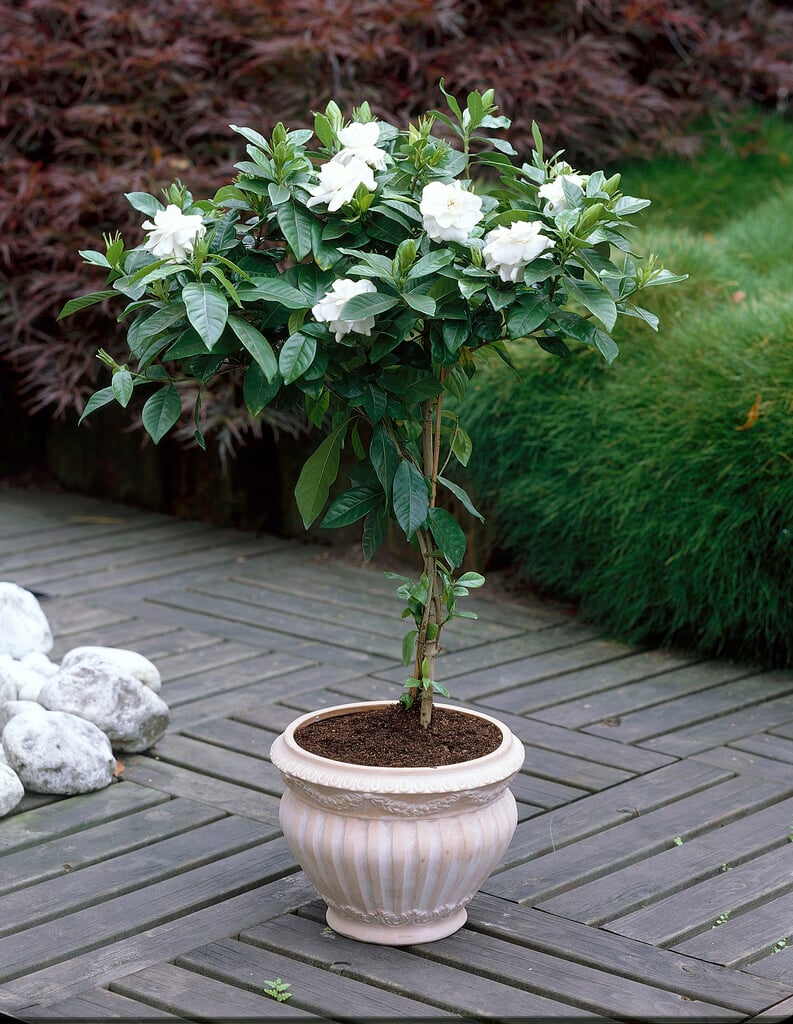
Gardenia jasminoides is an evergreen plant native to Asia, famous for its white, fragrant and rose-like flowers. She is much loved both in the garden and as a bonsai, for her natural elegance and for the intense fragrance of her flowers, which generally bloom between the end of spring and summer. Its shiny leaves, leathery and an intense green, combined with its ability to finely branch, make it perfect to be grown in bonsai pots, even if it requires more careful care than other essences. It is particularly suitable for styles such as the informal erect (moyogi) or the literary (bunjin). Ideal for bonsaists with a bit of experience, the gardenia rewards with a truly unique olfactory and visual spectacle.
Location
The Gardenia jasminoides is an outdoor species that prefers a bright environment but not too exposed to the direct sun and, especially in the hottest hours, it is recommended to place it in half shade, while in winter, in cold areas, it must be sheltered from frost, since it suffers from temperatures below 5–8 ° C. In mild climates it can winter outdoors with protection, otherwise it must be kept in a cold greenhouse avoiding drafts and temperature swings.
Watering
The common rule of watering that indicates to wet whenever the soil is dry to the touch, is ideal even in the case of Gardenia, considering that in the warmer periods, it is necessary to intervene more frequently. Often, in fact, in these cases the ground is likely to remain completely dry. It is also good to keep in mind that both the lack and the excess of water can create serious imbalances to the plant. Since Gardenia is an acidophilic plant, it is advisable to use decalcified water for watering. It waters abundantly in spring and summer, leaving the soil to dry slightly. In winter, however, it is necessary to water in moderation, a period in which water stagnations must also be avoided. She likes to be sprayed frequently on the leaves. Since this species consumes a lot of water, in summer it may be necessary to water even three times a day otherwise it loses vitality.
Repotting
It is applied in late spring, before the appearance of the buds, every 2-3 years, pruning the roots for at least 1/3 of their length. Eliminate the grown thick roots, pruning well the entire root system so that even the thin roots do not remain too long, otherwise they tend to rot. The most suitable soil for this species is the 100% kanuma, a typical earth for acidophiles that, in addition to having a good humidity, is characterized by a high water retention. In the period after the transplant it is recommended to nebulate the leaves frequently and water the soil only when it is dry.
Pruning
After flowering it is good to shorten the branches, leaving three leaves. To fully prune a branch you operate from May to June, without forgetting to use the mastic to protect the wounds. After flowering, it is necessary to carry out a thinning pruning, especially shortening the strongest branches.
Stabbing
You can have the flowers near the base of the branches, if you ply the new vegetation at the end of all the branches in May. To correct the silhouette of the tree, shorten the branches to two knots during the summer vegetative period.
Winding
You can wrap it in May-June, as the branches in this period are very flexible and you do not risk splits. To damage the plant as little as possible, it is recommended to apply the thread only on the branches and lignified shoots and to cover it with adhesive paper before wrapping it.
Fertilization
It loves abundant fertilizations, so it is advisable to fertilize throughout the vegetative period from April to October, using slow-divesting organic fertilizers such as Hanagokoro, or liquids, such as those of the Bonsan Line. Administrations should be stopped during flowering, or the fall of the flowers.
Cure
This species is particularly sensitive to cochineals and aphids, from which unfortunately it is often attacked even at the level of the root system. The phytopathological checks must be carried out, therefore, also with attention to the roots, to ensure that in them dangerous parasites do not lurk, which, contrary to what happens for other species, can cause a severe deterioration and in the most serious cases even the death of the tree. A suggestion: the leaves lose shine and the flowers fall if the plant is kept too dry or in an area with insufficient light.
0 commenti :
Post a Comment