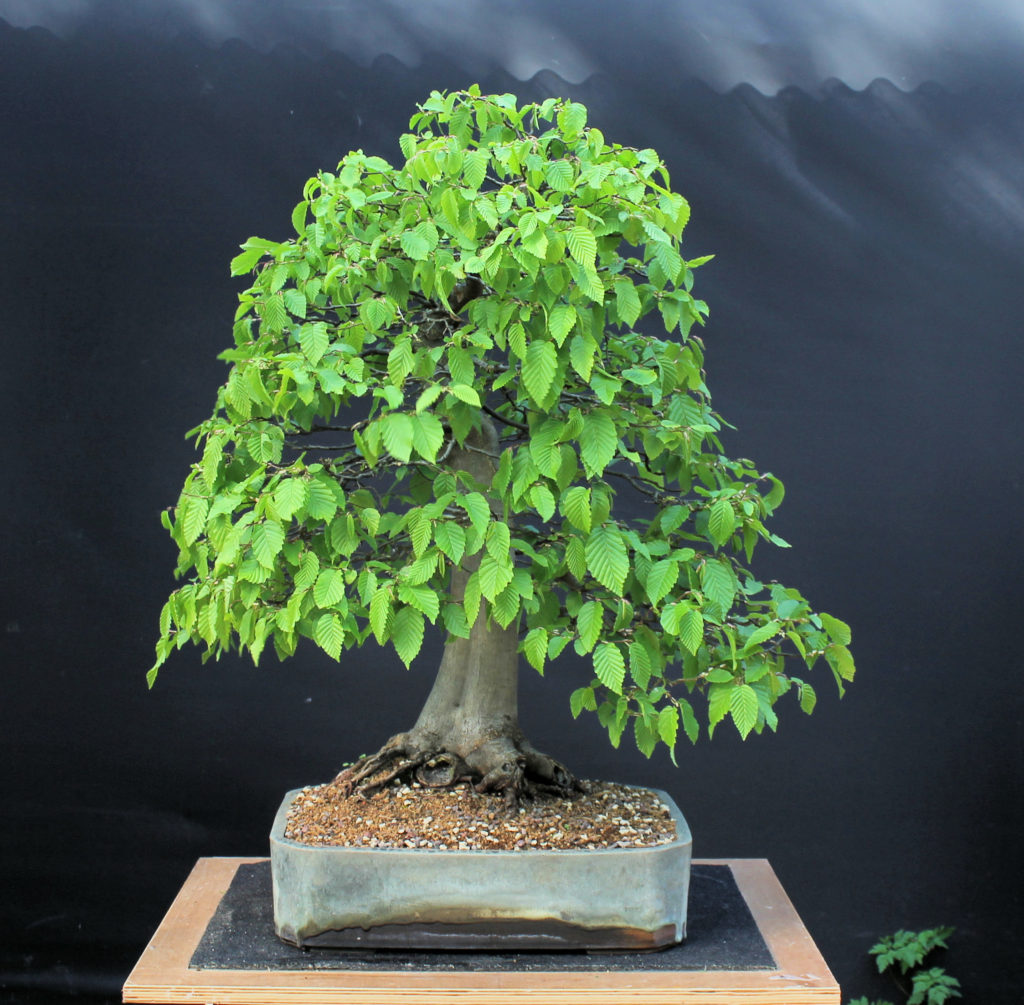
Bonsai cultivation of this plant is quite widespread as it possesses both a fine, slender branching habit and also a well-balanced trunk. With the exception of the formal upright, the Hornbeam can be trained in any style and is particularly valued when trained as a medium-sized bonsai tree. The varieties most frequently used in the East for bonsai creation are the Carpinus turkzaninowii, Carpinus cordata, Carpinus laxiflora and Carpinus coreana, while in Europe and America the oriunda species is the Carpinus betulus, which is quite widespread and is perfectly adaptable to bonsai cultivation.
Location
With the exception of the hottest months of the year, when it is best to provide this species with partial shade, hornbeam should always be placed in full sun, bearing in mind, however, that its roots are quite sensitive to intense heat and could easily burn. To ensure that the plant only benefits from sunlight, without its root system being affected, it is advisable to maintain a constant layer of moss on the surface of the substrate. Again, due to the particular conformation of its roots, during the harshest periods of winter it should be protected from frost by placing it in a sheltered location.
Watering
The common rule of watering whenever the soil feels dry to the touch is also ideal for hornbeam, bearing in mind, however, that in hotter periods and in strong winds, it is necessary to water more frequently. In fact, in these cases, the soil often risks becoming completely dry. It is also important to bear in mind that both a lack of water and excess water can cause serious damage to the plant. More specifically, a lack of water causes the leaves to wilt and stunted growth, while excess water causes the tips of the leaves to turn black.
Repotting
Repotting is done in March, when the buds begin to swell, pruning the roots and completely removing the old and rotten ones. It should be noted that in the first ten years of the plant's life, repotting should be done every two years, while subsequently it may be possible to wait longer before repotting is necessary. The most suitable soil mixture consists of akadama (80%) and ready-made soil (20%).
Pruning
The hornbeam tends to lose branches in winter, so pruning should be done in early spring. One way to avoid, or at least reduce, this tendency is to keep the silhouette of the branches very defined, so that air and light can reach all parts of the tree. To redefine the silhouette, cut the new shoots to 2 or 3 nodes. When pruning, it is advisable to let the shoots grow and only then shorten them considerably, otherwise there is a risk of sap withdrawal during the winter. Another form of pruning, which concerns branches with moderate growth, is the elimination of the last shoot, which is generally very large compared to the rest: by cutting it in spring, the branch will appear more proportionate. Since the apex of the hornbeam is quite vigorous, it needs to be pruned more aggressively than other areas to ensure better energy distribution in the plant. In this sense, it is essential that there are no branches at the apex that are too strong in relation to the thickness of the trunk and the size of the main branches.
Pinching
Carpinus branches do not require heavy pruning. However, it should be noted that its leaves grow alternately on the branches, so when pruning, the direction in which the new shoot will develop must be taken into account. Pruning can be light, using your fingers only on the new leaves that are forming, or more aggressive, cutting the rest of the branch with scissors and leaving only 2-3 leaves. Carpinus has a tendency to dry out its branches during the winter, so it is preferable to let the twigs grow and then pinch them back in the summer when they have thickened. Topping, which is mainly used to correct differences in vigor between branches, should be done when the shoots have just opened, pruning more aggressively on the strong ones and only slightly on the weak ones.
Wiring
To give the tree a good structure, you can also wrap it, taking care to do so at the right time of year, i.e. in spring or early fall. Since the bark is extremely delicate, the wire must be carefully covered with adhesive florist's tape and checked frequently to ensure that it does not squeeze the branches and/or trunk too tightly.
Fertilization
The hornbeam is a vigorous plant that benefits from regular fertilization during the growing season. From April to September (excluding the hottest summer months), we recommend using a slow-release solid organic fertilizer or a balanced liquid fertilizer every 2-3 weeks. In autumn, it is preferable to use a fertilizer with less nitrogen and more potassium to promote the lignification of the branches and prepare the plant for winter. During the dormant season, fertilization is not necessary.
Care
This species can be susceptible to moths, beetles, and powdery mildew. Hornbeam is also attacked by red spider mites, which, if the infestation is mild, can be eliminated simply by spraying the plant vigorously; if the infestation is quite severe, it is advisable to treat it with specific acaricides.
0 commenti :
Post a Comment