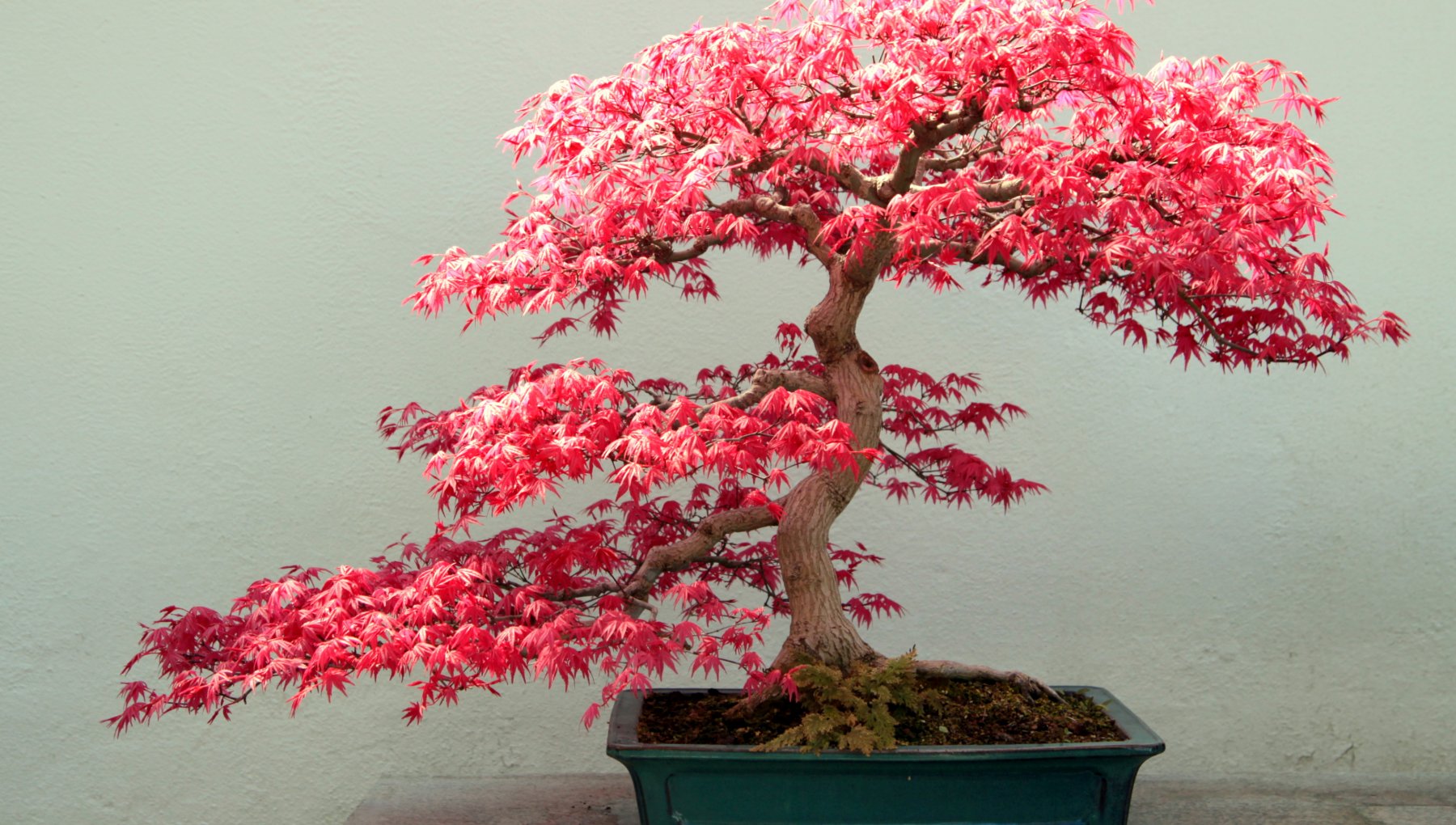
This Japanese ornamental plant with a long tradition is particularly appreciated for its continuous and spectacular transformations that follow the rhythm of the seasons: from the moment of the tender spring shoots to the lush splendor of the foliage during the summer, up to the magnificent red fire of its leaves in autumn.
No less interesting is when, after the fall of the leaves, it shows its elegant silhouette and the very fine and unmistakable branching. It is a robust species, generally able to withstand the cold as much as the heat. It is long-lived as a bonsai-cultivated essence, and is also easy to shape and responds well to cultivation techniques. Acer palmatum is cultivated in many varieties, including Kiyohime, Deshojo, Seigen, and is definitely a tree that can not miss in a collection.
Location
As already mentioned, it is a rather resistant plant both in terms of heat and cold. However, in order not to damage its beautiful foliage, it is good to protect it from the most intense summer sun rays, while it should not be subtracted from a total exposure to the sun in autumn, since this intensifies the coloring of the foliage. In winter, despite tolerating low temperatures, it is better to repair the root system from frosts.
Watering
The common rule of watering that indicates to wet whenever the soil is dry to the touch, is also ideal in the case of maple, considering that in the warmest periods and in the presence of strong wind, it is necessary to intervene more frequently. Often, in fact, in these cases the ground is likely to remain completely dry. It is also good to keep in mind that both the lack and the excess of water can create serious imbalances to the plant. More precisely, the lack of water causes the leaves to afflox and stunted growth; the excess causes a blackening of the leaves in the apex part.
Repotting
The transplant should be carried out in the spring when the buds swell, but before the appearance of the leaves; annually on the younger plants, every 2/3 years on the most mature. The ideal compound is 60% akadama + 30% ready ground + 10% pozzolana.
Pruning
The best period to carry out a selective pruning of the branches of the Maple is the period in which the fall of the leaves occurs in autumn (about 15/20 days), since it is possible to observe more clearly the complete structure, also there is no risk of loss of lymph since the plant is at rest. They can also be pruned to vegetative recovery but with less success. Especially the big branches should not be pruned during the growth period. Even the application of scarring paste would not be able to stop the lymph leakage. As for thinning pruning, it should be borne in mind that the gems of the Maples appear in pairs, one on each side of the branch. By selecting the buds and the proper pruning of the branches, the new sprouting will respect the direction of the chosen gemstone. Following a good pattern, based on the direction of the main branch, the secondary and tertiary branches must not cross, but form a dense and complete horizontal network. Once the frond is formed, which is obtained in about 5 years, every 4-5 years it is necessary to prune the tree vigorously to maintain its size and design.
Stabbing
It operates on the specimens already formed, in spring, to avoid the extension of new shoots. The topping will have to continue throughout the growth period. On the specimens in formation the technique of defoliation is adopted, approximately every 2 years in May / June, eliminating the leaves all or in part, but maintaining the petiole, in order to increase the finer branching.
Winding
It must be said that due to the delicate bark of the maple, the shaping is obtained above all through pruning, so the winding must be applied only in cases of absolute necessity, in the period of minor activity, to prevent it from affecting the elegant bark. The thread, due to the rapid growth rate of this species, must never remain for more than two three months.
Fertilization
From April to the beginning of July, administer the Bonsan Organic Liquid Fertilizer every 15 days together with the Bonsan Stimulating Fertish, or, once a month, Bonsan Organic Solid Fertilizer Hanagokoro plus the Bonsan Stimulating Fertilizer. From the end of August to October fertilize every 15 days with Organic Liquid Fertilizer Bonsan or with Bonsan Organic Solid Fertilizer Hanagokoro. Twice a year (in autumn and late winter) administer Bonsan Organic Solid Fertilizer Hanagokoro; 3-4 times a year it is also appropriate to intervene with the Bonsan Mineral Curative Solution. To stimulate rooting, use Organic Mineral Fluid Fertilizer with B Bonsan vitamins instead of Bonsan Organic Liquid Fertilizer.
Cure
The pathogens most often found on this species are aphids, red spider and powdery spray. Attacks generally occur between spring and early autumn. In the case of aphids, specific acid shall be applied every 10 days, carrying out at least 3 interventions. To prevent the formation of the red spider, it is good to keep the plant in a ventilated environment: in case of attack intervene with acaricide.
0 commenti :
Post a Comment