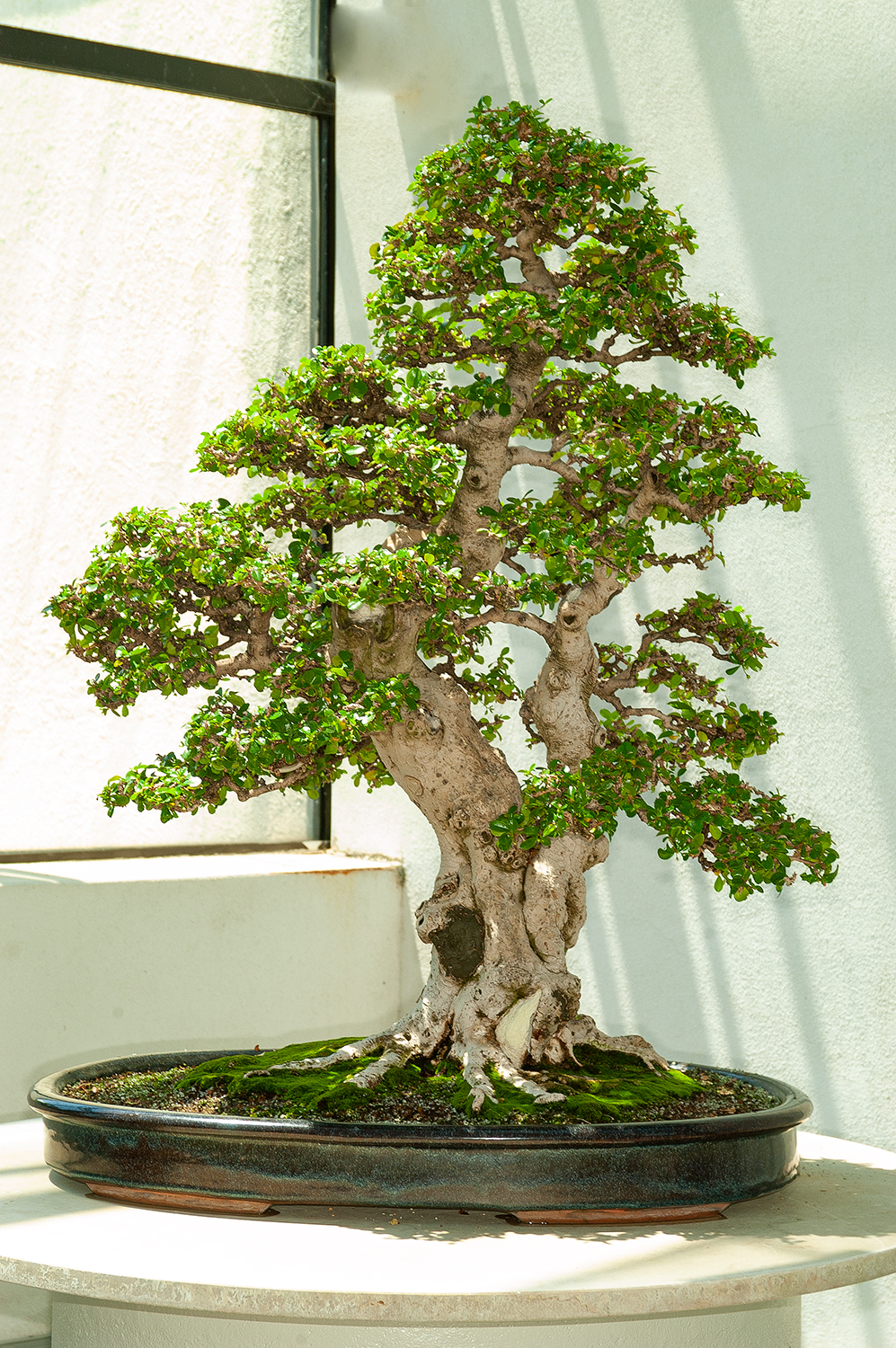
Carmona, also known as Fukien Tea Tree / 'tea plant', is a tropical plant that is popular in bonsai due to its shiny, compact foliage and flowering in spring and summer. Native to south-east Asia, Carmona is an evergreen that is well suited for indoor cultivation. It is ideal for those who want a decorative year-round bonsai due to its persistent leaves and star-shaped white flowers.
Location
Since it is a tree of tropical origin, it needs constant high temperatures, which is why it is classified as an indoor bonsai. From late spring onwards, it can be placed on the terrace, balcony, or in the garden, but when the outside temperature drops below 13°-15°C, it must be placed indoors or in a sheltered location where it can be guaranteed a light source less than 1 meter away and a temperature between 15° and 24°C. When placed outdoors, it can withstand direct sunlight without any problems, except during the hottest summer months, when it should be placed in partial shade.
Watering
The common rule of watering whenever the soil feels dry to the touch is also ideal for Carmona, but bear in mind that during hotter periods and in strong winds, you will need to water more frequently. In fact, in these cases, the soil often risks becoming completely dry. It is also important to bear in mind that both a lack of water and excess water can cause serious imbalances in the plant. More specifically, a lack of water causes the leaves to wilt and stunted growth, while excess water causes the leaves to blacken at the tips.
Repotting
ransplanting is carried out every 3-5 years in late spring or early summer. Carmona has fine, dense roots that must be pruned carefully, never drastically. The ideal substrate must be very well-drained but capable of retaining moisture slightly. The ideal mixture is 60% akadama + 30% ready-made soil + 10% pozzolana.
Pruning
Pruning can be done at any time of year, although it should be noted that the most suitable time is early spring, and the least recommended is winter. Although Carmona is not particularly weakened by the operation, it is obviously essential to cover large cuts with healing mastic. To shape Carmona, the Lignan method is applied, which consists of “letting it grow and pruning”: trees shaped using this system have marked angles, abrupt splits, and half-closed scars, giving them a rather ancient and charming appearance. However, the most commonly used pruning technique is thinning, which involves removing branches that grow in unsuitable positions: those that cross with others, grow upwards or downwards, etc. This technique is mainly used in the spring months and sporadically in winter.
Pinching
To refine the structure and silhouette of the tree, prune any shoots that are too long. The best way to do this is to use special bonsai scissors, cutting back to 2 or 3 leaves each time the shoots have 7/10 leaves.
Wiring
Wrapping is only used in extreme cases, i.e., only if there are no alternatives for shaping a branch, since Carmona, despite its appearance, has very fragile branches. In addition, its bark is particularly delicate and the wire can cut into it even during the wrapping stage if too much pressure is applied. If you really feel you need to apply wire, it is best to use the tie-down system, anchoring the wire to a lower part of the trunk or to the container. With this method, it is possible to lower the branches that grow from the trunk and tend to grow upwards instead of horizontally.
Fertilization
When growth resumes (March-April), fertilize every 8-10 days, combining Bonsan Stimulating Action Fertilizer with Bonsan Organic Liquid Fertilizer. From April to September, fertilize every 8-10 days with Bonsan Organic Liquid Fertilizer or every 25-30 days with Bonsan Aburukasu Organic Solid Fertilizer, avoiding July and August. From September to February, it is advisable to use Bonsan Organic Liquid Fertilizer every 15-20 days. To stimulate rooting, use Bonsan Organic Mineral Fluid Fertilizer with B vitamins instead of Bonsan Organic Liquid fertilizer.
Care
he pathogens that can affect Carmona are aphids and scale insects, against which it is advisable to use a systemic insecticide when the first symptoms appear. In any case, if the plant is properly cared for, it is unlikely to be attacked by insects, mites, or fungi.
0 commenti :
Post a Comment